The color game feels like a coin flip with extra excitement, but the numbers tell a different story. This article works out the exact color game odds, the payouts, and the house edge, using simple fractions you can check yourself. It is the math chapter of our Color Game Guide.
The basic setup
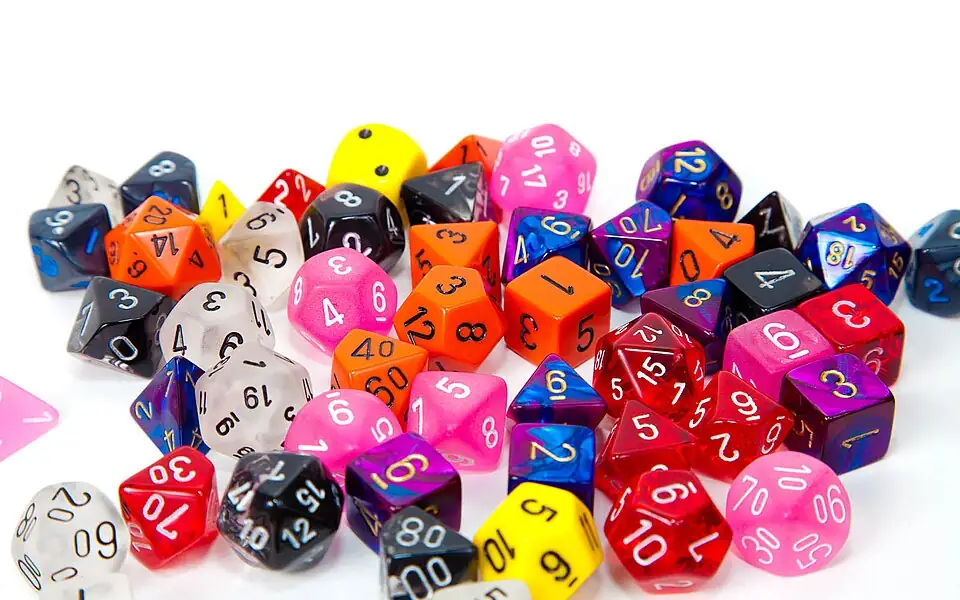
There are three dice, and each has six equally likely colors. That gives 6 × 6 × 6 = 216 possible outcomes. For any color you choose, each die has a 1-in-6 chance of matching and a 5-in-6 chance of missing.
Probability table
| Matches | Ways (of 216) | Probability | Payout | Visual |
|---|---|---|---|---|
| 0 dice | 125 | 57.87% | Lose stake | |
| 1 die | 75 | 34.72% | 1:1 | |
| 2 dice | 15 | 6.94% | 2:1 | |
| 3 dice | 1 | 0.46% | 3:1 |
Add up the winning rows and you get 91 of 216, or 42.13%. So you lose a single-color bet more often than you win it. Many players assume "three dice, six colors" means a 50% chance. It does not.
The house edge, explained
The expected value of a ₱1 bet is the average result per round over the long run:
EV = (75 × 1 + 15 × 2 + 1 × 3 − 125 × 1) ÷ 216 = −17/216 ≈ −7.87%
In plain terms, the theoretical return to player is about 92.1%. That is a bigger edge than many slot games (often 94–97% RTP) and much bigger than skill-based games like poker, where you play against other people. It is the same shape of edge found in chuck-a-luck, the color game's Western cousin.
Some online versions add random multipliers on certain rolls. Those change the payout table, and therefore the RTP, so always read the game rules or the published RTP figure.
Betting on several colors
Spreading chips across colors changes how often you see a win, not the long-run cost. Each individual bet still carries the same −7.87% expectation, so covering more colors simply means wagering more per round. Covering all six colors does not create a sure profit. It slowly drains your balance while feeling like you "always win something". We bust this and other ideas in Color Game Strategy: Myths vs Facts.
What it means for your budget
Suppose you play 100 rounds at ₱50 a round. You will wager ₱5,000 in total, and the expected loss is about ₱394. Short-term results swing wildly, which is exactly why the game is exciting, but over time the math wins. Practical tips:
- Treat your budget as the cost of entertainment, like a movie ticket.
- Use small, fixed bet sizes, and avoid the Martingale doubling system.
- Set a time limit as well as a money limit.
- Read our responsible gaming guide and use the limits your operator offers.
See these probabilities play out live in our free color game roller. It tracks your hit rate against the 42.1% expectation. For general questions, visit the FAQ.
Quick FAQ
What are the odds of winning color game?
Your chosen color appears on at least one of the three dice 91 times in 216, or about 42.1% of rounds.
What is the house edge in color game?
With the standard 1:1, 2:1 and 3:1 payouts, the house edge is 17/216, about 7.87%. Over many rounds you can expect to lose about ₱7.87 for every ₱100 wagered.
AI-assisted content: This page was drafted with the help of AI tools and reviewed by Steven Watson. It is for information and entertainment only and is not financial or legal advice. How we write.